In this project, selected texts from the 18th century are examined using modern technologies. Large language models (LLMs) and vision language models (VLMs) are used to analyse both the historical typefaces and the language.
A central goal is to transfer the contents of the books into a structured output format – for example a database – so that they become accessible to further scientific analysis.
Research question
How can extensive printed works from the 18th century be converted into structured data reliably and traceably – so that historians can trust the results and check them themselves?
The example: a household encyclopaedia
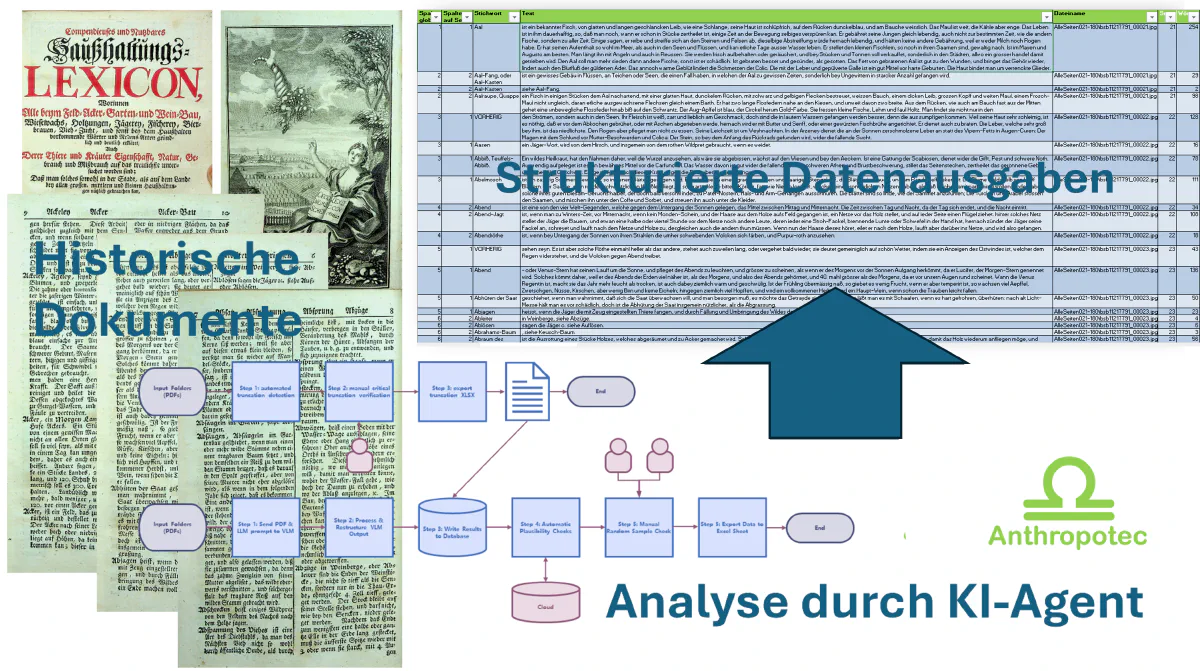
Our test object is the “Compendieuses und Nutzbares Haußhaltungs-Lexicon”, a household encyclopaedia from the 18th century. In alphabetical headwords it describes what was worth knowing at the time about the household, field, arable, garden and wine growing, livestock farming, hunting and fishing – from eel (“Aal”) to clearing (“Abraum”). It is thus a window into the everyday life, language and knowledge of that era.
Origin of the method
The approach was first developed for cataloguing historical music prints. We transferred it to the household encyclopaedia – from music prints with title page, dedication and index to an extensive reference work.
Working on two levels
Document level. First, the work as a whole is examined: what page types are there – binding, title page, preface, encyclopaedia pages, index? This produces a document profile and a semantic memory that accompanies every single page. The system thus “knows” which work it is reading and where.
Page level. Then each page is passed as an image to a vision language model. It captures script and page layout at the same time: it recognises headwords, columns and text sections and transcribes the Fraktur type into modern characters. It is steered by structured instructions that suit the page type and by suitable examples retrieved from a vector database (retrieval-augmented generation).
The results are written to a database – each entry with headword, text, page, column, word count and source file – and can be exported as a spreadsheet.
Check, don’t trust
- VLM reads page
- Database
- Plausibility check
- Second model · GND matching
- Critical review
- Manual spot check
- Spreadsheet
What happens next is decisive. Automatic plausibility checks detect, for example, entries that were continued or cut off across column or page boundaries; these passages are then reviewed critically. A second model checks the results with a varied context, and recognised place names are matched against the German Integrated Authority File (GND). In addition, experts check random samples by hand.
Why this stands for explainable AI
Language models produce fluent, convincing texts – even when they are wrong. That is why we do not rely on a single model but surround it with an explainable shell of steering, context, standardisation, memory and checking. Every entry can be traced back to the original page.
Foundations: the shell model – how an explainable layer forms around the AI model →Status and outlook
The processing chain has been built as a prototype and is being tested on the household encyclopaedia. Next, further works from the history of Chemnitz and Saxony are to be opened up. The method can be transferred to other sources – such as letters, files, business papers or concert programmes.